
Amazing Space Facts for Kids: Explore Our Universe! at a Glance
Topic Focus
Amazing Space Facts for Kids: Explore Our Universe!
Learning Level
Ages 4–10 (Preschool to Grade 4)
Subject Area
Space Facts
Format
Verified Fun Facts & Guided Exploration
Amazing Space Facts for Kids: Explore Our Universe!
Have you ever looked up at the night sky and wondered what’s out there? The universe is a vast and mysterious place, filled with sparkling stars, distant planets, and incredible galaxies. It’s much bigger than anything we can imagine, and there’s always something new to discover!
From the tiny moon orbiting our Earth to enormous black holes, space is packed with wonders. Learning about the universe helps us understand our home planet better and sparks our curiosity about what else might be waiting to be found. Get ready to blast off on an adventure through the cosmos and uncover some truly amazing space facts!
We'll explore everything from our own solar system to the farthest reaches of space, learning about the incredible objects and phenomena that make up our universe. You'll discover why the sky is blue, how stars are born, and even what a light-year is!
The universe is an endless book of wonders, just waiting to be read.
Quick Facts
Earth is not perfectly round; it's an oblate spheroid, a bit squashed at the poles.
A day on Venus is longer than a year on Venus.
The Sun is a star, and it's so big that over a million Earths could fit inside it.
There are more stars in the universe than grains of sand on all the beaches on Earth.
The highest mountain known in our solar system is on Mars, called Olympus Mons.
Light from the Sun takes about 8 minutes and 20 seconds to reach Earth.
Saturn's rings are mostly made of billions of tiny pieces of ice and rock.
Our Home in Space: The Solar System
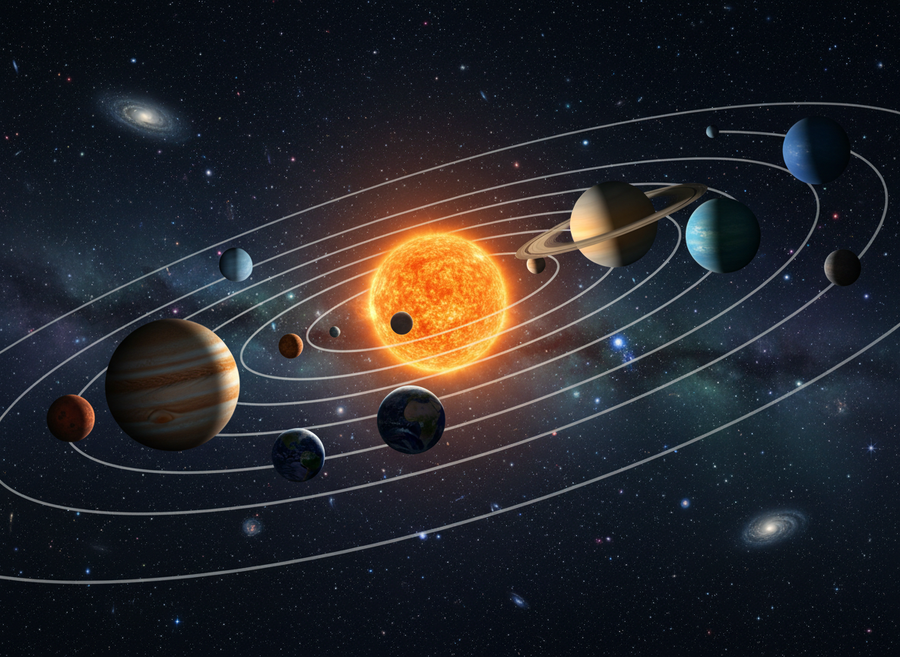
Our journey begins right here in our own neighborhood: the Solar System! This is where our Earth lives, along with seven other planets, countless moons, asteroids, and comets. Everything in our Solar System, including us, orbits around one giant star: the Sun. The Sun is like the boss of our Solar System, pulling everything towards it with its strong gravity.
Each planet in our Solar System is unique. Mercury is super hot and closest to the Sun, while Neptune is incredibly cold and farthest away. Earth is special because it has liquid water and the right temperature for life to thrive. Did you know that Jupiter is the biggest planet? It’s so massive that all the other planets could fit inside it! And Saturn is famous for its beautiful rings, which are made of billions of icy particles.
Mercury: The smallest planet and closest to the Sun.
Venus: Known for its extremely hot surface and thick, toxic atmosphere.
Earth: Our home, the only planet known to support life.
Mars: The 'Red Planet,' often studied for signs of past or present life.
Jupiter: The largest planet, a gas giant with a famous Great Red Spot storm.
Saturn: Known for its magnificent system of rings made of ice and rock.
Uranus: An ice giant that rotates on its side.
Neptune: The farthest planet from the Sun, a very cold and windy ice giant.
Stars, Galaxies, and Beyond!
Beyond our Solar System, the universe opens up to an even grander scale. Stars are giant balls of hot, glowing gas, just like our Sun. They look tiny to us because they are incredibly far away. When you look at the night sky, every twinkling light you see (that isn't a planet) is a star, some even bigger and brighter than our Sun!
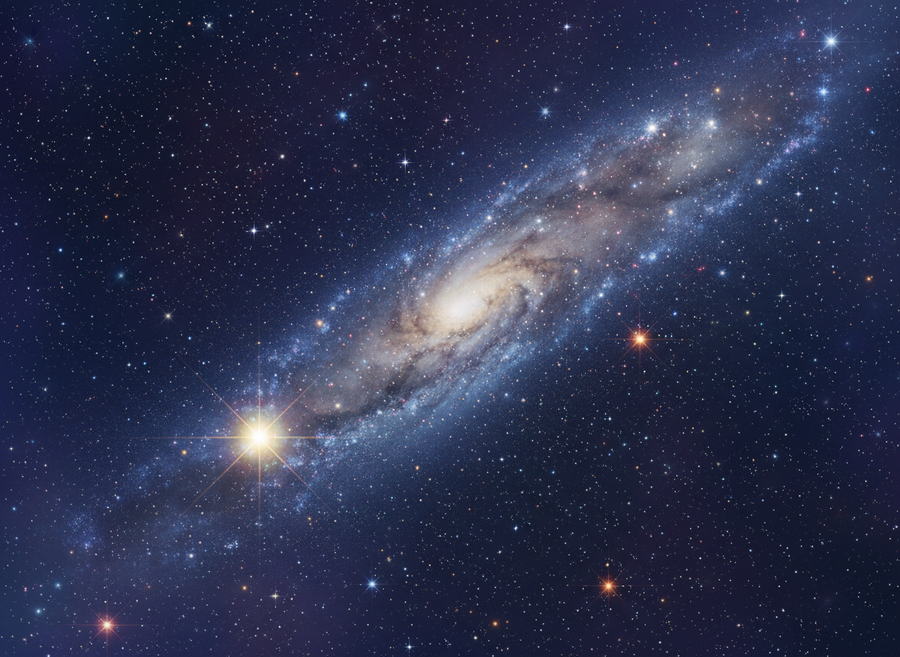
Stars aren't alone; they often group together in huge collections called galaxies. Our Sun is part of a galaxy called the Milky Way. The Milky Way looks like a giant spiral, and it contains billions of stars, along with gas, dust, and dark matter. Imagine trying to count all those stars! And guess what? There are billions of galaxies in the universe, each with billions of stars. It's an almost unimaginable number!
Some stars end their lives in spectacular explosions called supernovas, while others might shrink down to become tiny, super-dense neutron stars or even mysterious black holes. Black holes are regions in space where gravity is so strong that nothing, not even light, can escape. They are some of the most fascinating and powerful objects in the universe.
What is a Light-Year?
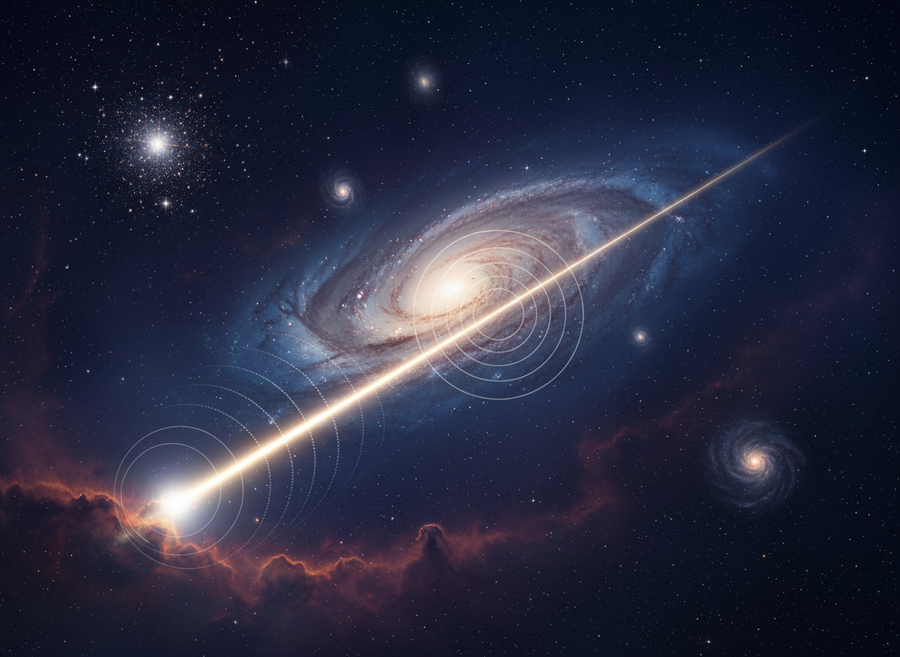
When we talk about distances in space, our usual measurements like miles or kilometers just aren't big enough. That's why scientists use something called a 'light-year.' A light-year is not a measure of time; it's a measure of distance. It's how far light travels in one whole year.
Light travels incredibly fast, about 186,282 miles (299,792 kilometers) per second! So, in one year, light travels about 5.88 trillion miles (9.46 trillion kilometers). That's a huge number! When we say a star is 10 light-years away, it means the light we see from that star today actually left the star 10 years ago. It took that long for the light to travel all the way to our eyes.
This concept helps us understand just how immense the universe is. The stars and galaxies we observe are often millions or even billions of light-years away, meaning we are looking back in time when we see them. It's like a giant cosmic time machine!
Why is the Sky Blue? (And What About Space?)
Have you ever wondered why the sky is blue during the day? It's all thanks to Earth's atmosphere! Our atmosphere is a layer of gases surrounding our planet. Sunlight, which looks white to us, is actually made up of all the colors of the rainbow. When sunlight enters our atmosphere, the blue light scatters more than the other colors because it travels in shorter, smaller waves.
This scattered blue light spreads across the sky, making it appear blue to our eyes. At sunset or sunrise, the sunlight has to travel through more of the atmosphere, scattering away most of the blue light, which is why we often see beautiful reds, oranges, and yellows.
But what about space itself? If you were an astronaut floating in space outside Earth's atmosphere, the sky wouldn't be blue at all. It would be a deep, dark black, even with the Sun shining brightly. This is because there's no atmosphere in space to scatter the sunlight. Without anything to scatter the light, space appears as a vast, dark void, filled with distant stars and galaxies.
Want to bring the wonders of space closer? You can explore and color amazing space scenes right here on KidsColouringPage.com! We have lots of free printable pages and online coloring activities featuring planets, astronauts, rockets, and more.
Educational Standards & Fact-Checking
Reviewed by KidsColouring Editorial Team
Educational References & Scientific Sources
Our curriculum and factual articles are synthesized from trusted academic encyclopedias, wildlife conservation bodies, and public science institutions:
- •Smithsonian Institution Educational Resources & National Zoo Archives — Smithsonian Institution
- •National Geographic Kids Science & Animal Encyclopedias — National Geographic Society
- •Encyclopaedia Britannica Academic & Elementary Learning Reference — Encyclopaedia Britannica


