Octopus Facts for Kids: Eight Arms of Ocean Wonder!
Imagine an animal that can change its color in a blink, squeeze through tiny spaces, and even solve puzzles! Sounds like a superhero, right? Well, meet the octopus! These incredible creatures live in the ocean and are full of surprises. They might look a little alien with their eight arms and big eyes, but octopuses are some of the smartest and most fascinating animals on our planet.
From the shallow coral reefs to the deepest parts of the ocean, octopuses have found ways to thrive. They are masters of disguise, clever hunters, and even build amazing homes. Get ready to dive into the watery world of the octopus and discover what makes these eight-armed wonders so special. You'll be amazed by their super senses, incredible abilities, and how they navigate their underwater world!

An octopus is like a superhero of the sea, with eight arms, super camouflage, and a brilliant mind!
Quick Facts
- Octopuses have three hearts!
- They can change their skin color and texture in less than a second.
- An octopus can squeeze through any opening larger than its beak (the only hard part of its body).
- They are invertebrates, meaning they don't have a backbone.
- Octopuses are known to be very intelligent, capable of solving mazes and opening jars.
- Most octopuses live for only 1 to 2 years.
- They use jet propulsion to move through water, sucking in and shooting out water.
- Female octopuses protect their eggs fiercely, sometimes for months without eating.
What Makes an Octopus an Octopus?
First things first, an octopus is a type of animal called a cephalopod. That's a big word that means 'head-foot'! This name makes sense because an octopus's arms are attached directly to its head. Unlike fish, octopuses don't have bones inside their bodies, which makes them incredibly flexible. The only hard part of an octopus is its beak, which is like a parrot's beak and is used for cracking open the shells of their prey.
Octopuses are found in all of the world's oceans, from the cold polar waters to the warm tropical seas. There are over 300 different kinds of octopuses, and they come in all sorts of sizes, from the tiny 'star-sucker' octopus, which is about the size of a pea, to the giant Pacific octopus, which can weigh over 600 pounds and stretch across 30 feet – that's longer than a car!

Masters of Disguise: The Art of Camouflage
One of the most amazing things about octopuses is their incredible ability to change their appearance. They are the ultimate masters of disguise! Octopuses can change the color, pattern, and even the texture of their skin almost instantly. How do they do this? They have special cells called chromatophores (say: KROH-muh-toh-fores) that contain different colored pigments. By controlling these cells, an octopus can blend in perfectly with its surroundings, whether it's a rocky seafloor, a sandy patch, or a colorful coral reef.
This camouflage isn't just for hiding from predators like sharks and dolphins; it's also a super-skill for hunting! An octopus can sneak up on its prey, like crabs and small fish, without being seen. Sometimes, they even use their camouflage to communicate with other octopuses, showing off patterns that might mean 'I'm here!' or 'Stay away!' It's like having a built-in magic trick for survival!

Super Smart and Super Strong
Octopuses are considered some of the most intelligent animals in the ocean. Scientists have observed them doing some truly amazing things:
- Solving Puzzles: They can learn to navigate mazes and even figure out how to open screw-top jars to get a treat inside.
- Using Tools: Some octopuses have been seen using coconut shells as portable shelters, carrying them around to hide in when danger approaches.
- Playing Games: They've been known to squirt water at people or objects, seemingly just for fun!
Their brains are quite unique. While they have a central brain like us, about two-thirds of an octopus's neurons (brain cells) are actually in its arms! This means each arm can act a little bit independently, almost thinking for itself, which helps them grab, feel, and explore their environment in many directions at once. Each arm is lined with powerful suction cups that can taste and grip, making them incredibly strong and sensitive.
Life in the Ocean: Homes and Habits
Octopuses are usually solitary creatures, meaning they prefer to live alone. They make their homes, called dens, in all sorts of places: rocky crevices, under stones, or even inside discarded human objects like old tires or bottles. They are very tidy and often decorate the entrance to their dens with shells, stones, or other objects they find, sometimes even creating a 'garden' around their home.
Most octopuses are nocturnal, meaning they are most active at night when they go out to hunt for food. They are carnivores, which means they eat meat, usually crabs, lobsters, shrimp, and small fish. They are also known for their unique way of moving. While they can crawl along the seafloor using their arms, they can also use jet propulsion to zoom through the water. They do this by sucking water into a special part of their body called the mantle and then squirting it out through a tube called a siphon, pushing themselves forward like a natural underwater rocket!
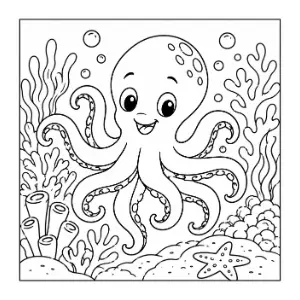
Want to see an octopus up close (without getting wet!)? You can find many free octopus coloring pages to print or color online right here at KidsColouringPage.com. It's a fun way to learn even more about these amazing ocean creatures!
Octopus Babies and Their Short Lives
The life of an octopus is often short but full of action. Most octopuses only live for 1 to 2 years, though some larger species can live a bit longer. During their lives, female octopuses lay thousands of tiny eggs, often hanging them in strings or clusters inside their den. The mother octopus then guards her eggs fiercely, sometimes for many months. She cleans them, protects them from predators, and makes sure they get enough oxygen by gently blowing water over them.
During this time, the mother octopus often doesn't leave her eggs, even to eat. This dedication means that by the time her babies hatch, she is very weak and usually dies soon after. The tiny baby octopuses, called paralarvae, hatch and float in the ocean currents, eventually settling down to grow and begin their own amazing lives in the deep blue sea. It's a cycle of life that shows just how dedicated these incredible mothers are!