
Amazing Moon Facts for Kids: Our Nighttime Neighbor! at a Glance
Topic Focus
Amazing Moon Facts for Kids: Our Nighttime Neighbor!
Learning Level
Ages 4–10 (Preschool to Grade 4)
Subject Area
Space Facts
Format
Verified Fun Facts & Guided Exploration
Amazing Moon Facts for Kids: Your Guide to Our Nighttime Neighbor!
Look up at the night sky, and what’s the first thing you usually see? The Moon! It’s Earth’s closest neighbor in space, a giant, dusty ball that lights up our nights. For thousands of years, people have looked at the Moon with wonder, telling stories about it and even dreaming of visiting its surface. It might seem far away, but the Moon is an important part of our world, influencing everything from ocean tides to the rhythm of our days.
Have you ever wondered why the Moon sometimes looks like a tiny sliver and other times a big, bright circle? Or what it would be like to walk on its surface, bouncing around because gravity is so much weaker? The Moon holds so many secrets and amazing stories, and we’re going to explore some of the most exciting ones right now. Get ready to become a Moon expert!
The Moon is Earth's loyal companion, always orbiting, always watching over us.
Quick Facts
The Moon is Earth's only natural satellite.
It takes about 27.3 days for the Moon to orbit Earth once.
The Moon has no atmosphere, meaning no air to breathe and no weather.
Its surface is covered in countless craters, formed by impacts from asteroids and comets.
The Moon is slowly moving away from Earth, about 3.8 centimeters per year.
Only 12 people have ever walked on the Moon, all of them American astronauts.
The 'dark side' of the Moon isn't always dark; it just means the side we can't see from Earth.
Temperatures on the Moon can be extremely hot (+120°C) or extremely cold (-170°C).
What is the Moon Made Of?
Imagine a giant rock, bigger than any mountain you’ve ever seen, floating in space. That’s kind of what the Moon is! Scientists believe the Moon formed billions of years ago, possibly after a huge object crashed into early Earth, sending a massive amount of material into space that eventually clumped together. It’s mostly made of rock and dust, similar to Earth’s outer layers. When astronauts visited the Moon, they brought back samples of lunar rocks, which helped us learn a lot about its composition.
The Moon’s surface is covered in a fine, powdery dust called regolith. This dust is created over billions of years as tiny meteorites constantly hit the Moon, grinding down the rocks. It’s so fine that astronauts’ footprints are still visible on the Moon’s surface today because there’s no wind or water to blow them away! Underneath this dusty layer, the Moon has a solid crust, a mantle, and a small, partly molten core, much like Earth.
Why Does the Moon Change Shape? (Moon Phases Explained!)
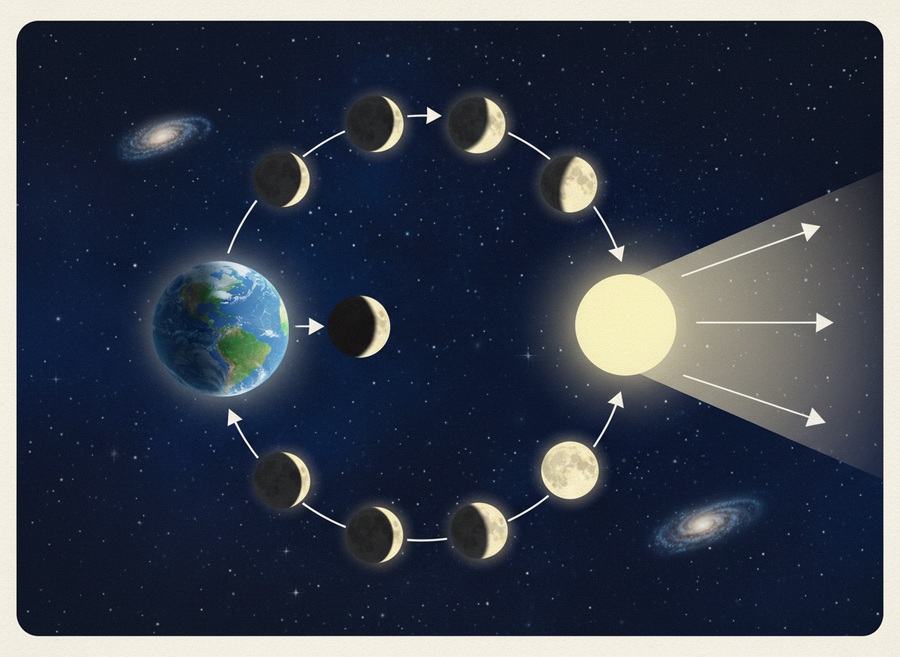
One of the most magical things about the Moon is how it seems to change its shape in the sky. One night it’s a tiny crescent, another night it’s a big, glowing circle, and sometimes it disappears completely! These changes aren't because the Moon is actually changing shape, but because of how much of the Moon’s sunlit surface we can see from Earth as it orbits us. This is what we call the Moon Phases.
Think of it like this: the Sun always lights up half of the Moon, just like it lights up half of Earth. As the Moon travels around Earth, we see different amounts of that lit-up half. Here are the main phases:
New Moon: The Moon is between the Earth and the Sun, so the side facing us is completely dark. We can't see it!
Crescent Moon: A small sliver of light appears, growing bigger each night.
First Quarter Moon: We see half of the Moon lit up (it looks like a D-shape).
Gibbous Moon: More than half of the Moon is lit, growing towards full.
Full Moon: The entire side of the Moon facing Earth is lit up by the Sun. It’s bright and round!
Last Quarter Moon: After the Full Moon, the lit part starts to shrink, becoming half-lit again (this time like a backward D).
The whole cycle, from New Moon to Full Moon and back again, takes about 29.5 days. This is how many ancient calendars were created!
Craters, Mountains, and Seas: What's on the Moon's Surface?
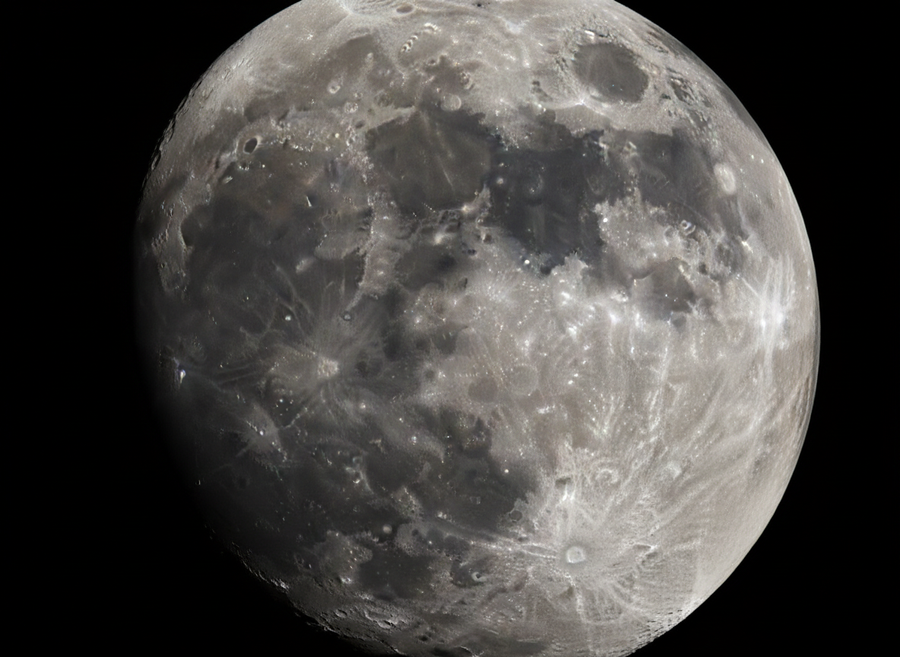
If you look closely at the Full Moon, you’ll see dark and light patches. The light patches are called highlands, which are mountainous, crater-filled areas. The darker, smoother areas are called maria (pronounced MAR-ee-uh), which means 'seas' in Latin. Early astronomers thought these dark areas were actual oceans, but we now know they are vast, flat plains of solidified lava from ancient volcanic eruptions.
The Moon is absolutely covered in craters! These bowl-shaped holes are formed when asteroids or comets crash into its surface. Because the Moon has no atmosphere, there's nothing to burn up incoming space rocks, and no wind or water to erode the craters away. So, once a crater is made, it stays there for millions or even billions of years, looking almost the same as the day it was formed. Some craters are tiny, while others, like the South Pole-Aitken Basin, are enormous, stretching thousands of kilometers wide!
Visiting the Moon: A Giant Leap for Humankind
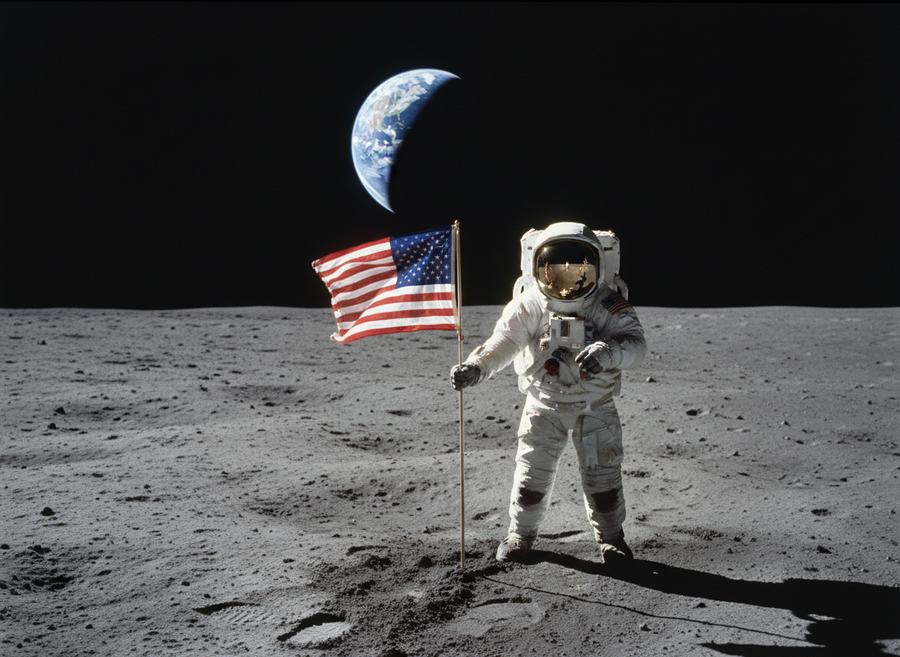
For centuries, people dreamed of going to the Moon. In the 20th century, this dream became a reality! On July 20, 1969, American astronauts Neil Armstrong and Buzz Aldrin became the first humans to walk on the Moon as part of NASA's Apollo 11 mission. It was an incredible achievement, watched by millions of people around the world. Imagine stepping onto another world, feeling lighter than you ever have, and looking back at Earth, a beautiful blue marble in the blackness of space!
In total, 12 astronauts walked on the Moon during the Apollo missions between 1969 and 1972. They collected Moon rocks, set up scientific experiments, and explored the lunar landscape. Their journeys taught us so much about our Moon, our solar system, and what humans are capable of. Today, space agencies around the world are planning new missions to the Moon, hoping to build lunar bases and learn even more about our amazing nighttime neighbor.
The Moon and Earth: A Special Relationship
The Moon isn't just a pretty light in the sky; it plays a very important role for Earth. One of its biggest jobs is creating the ocean tides. The Moon’s gravity pulls on Earth’s oceans, causing them to bulge out on the sides closest to and farthest from the Moon. This creates the high and low tides we see every day along our coastlines.
The Moon also helps stabilize Earth's wobble. Without the Moon, Earth would wobble much more on its axis, which could lead to extreme changes in climate over long periods. So, the Moon helps keep our planet steady and our climate more predictable, making it a better place for life to thrive. It’s a true cosmic dance partner, always orbiting, always influencing our home planet.
Educational Standards & Fact-Checking
Reviewed by KidsColouring Editorial Team
Educational References & Scientific Sources
Our curriculum and factual articles are synthesized from trusted academic encyclopedias, wildlife conservation bodies, and public science institutions:
- •Smithsonian Institution Educational Resources & National Zoo Archives — Smithsonian Institution
- •National Geographic Kids Science & Animal Encyclopedias — National Geographic Society
- •Encyclopaedia Britannica Academic & Elementary Learning Reference — Encyclopaedia Britannica


