
Journey to the Moon: The First Time Humans Landed! at a Glance
Topic Focus
Journey to the Moon: The First Time Humans Landed!
Learning Level
Ages 4–10 (Preschool to Grade 4)
Subject Area
Space Facts
Format
Verified Fun Facts & Guided Exploration
The First Trip to the Moon: A Giant Leap for Humankind!
Imagine looking up at the night sky and seeing the Moon, a bright, mysterious circle far, far away. For thousands of years, people dreamed of visiting it, wondering what it would be like to stand on its dusty surface. It seemed like something out of a fairy tale or a wild adventure story. But in the 1960s, that dream started to become a real possibility. Scientists and engineers worked tirelessly, building incredible machines and planning the most daring journey humanity had ever attempted.
This wasn't just a trip; it was a race! Many countries wanted to be the first to reach the Moon. The United States, with its space agency NASA, took on this challenge with a program called Apollo. And on one amazing summer day, in 1969, all that hard work paid off. A powerful rocket blasted off, carrying three brave astronauts on a mission that would change how we see our place in the universe forever. Get ready to explore the exciting story of humanity's first visit to our closest celestial neighbor!
That's one small step for man, one giant leap for mankind.
Quick Facts
The first mission to land humans on the Moon was Apollo 11.
It launched on July 16, 1969, from Florida, USA.
The three astronauts were Neil Armstrong, Buzz Aldrin, and Michael Collins.
Neil Armstrong was the first person to walk on the Moon.
The Moon landing happened on July 20, 1969.
The spacecraft was called Columbia, and the lunar lander was named Eagle.
The astronauts spent about 2.5 hours walking on the Moon's surface.
They brought back Moon rocks and soil for scientists to study.
The Dream Takes Flight: The Apollo Program
Before anyone could even think about walking on the Moon, a lot of planning and practice had to happen! The Apollo program was a huge effort by NASA, the American space agency. Its main goal was to land humans on the Moon and bring them back safely to Earth. This wasn't just one mission; it was a series of missions, each one learning more and more about space travel. Early Apollo missions tested the rockets, the spacecraft, and how astronauts could live and work in space. They even orbited the Moon without landing, taking pictures and scouting out safe spots for future landings.
Imagine building something as tall as a 36-story building, powerful enough to escape Earth's gravity, and precise enough to travel over 200,000 miles to a moving target! That's what the Saturn V rocket was. It was the biggest and most powerful rocket ever built at the time, specifically designed to carry the Apollo spacecraft and its precious cargo of astronauts all the way to the Moon. Without this incredible machine, the dream of a Moon landing would have remained just a dream.
Meet the Brave Crew of Apollo 11
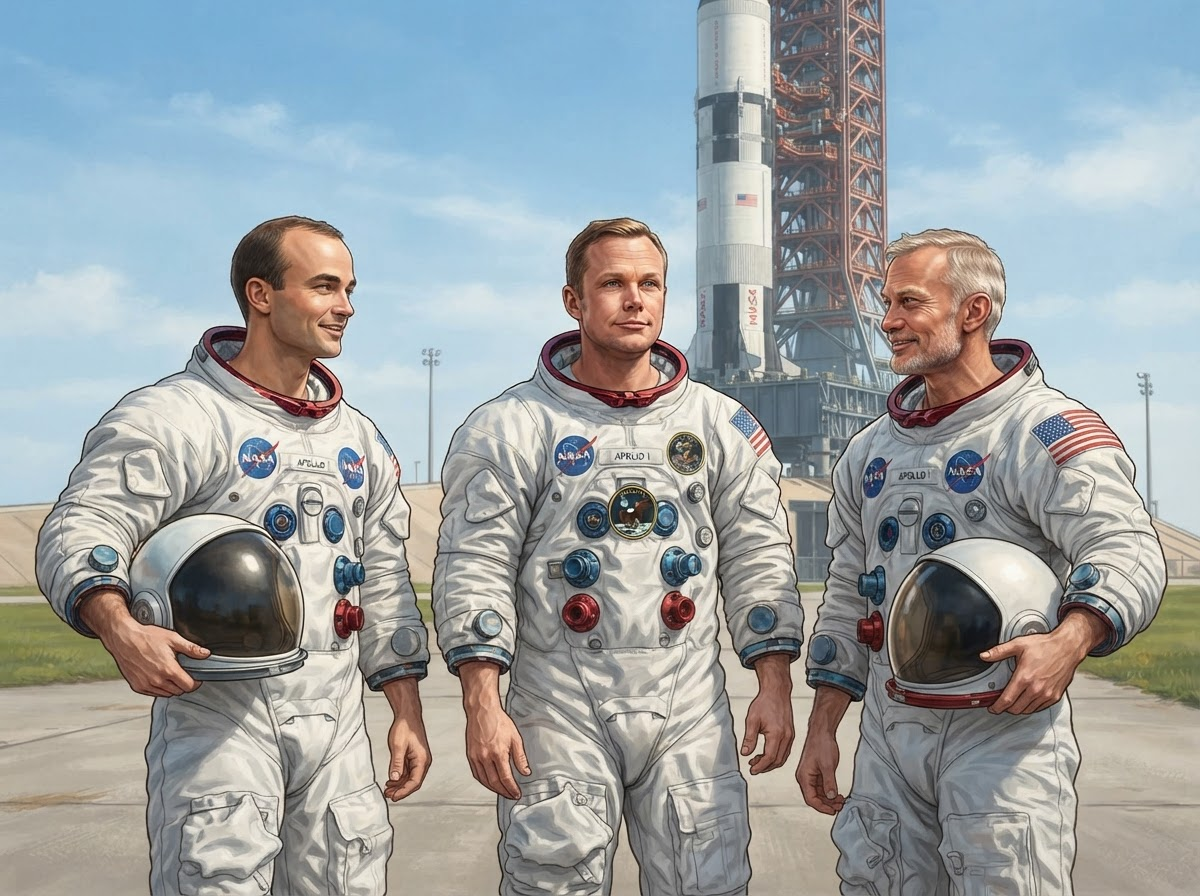
Every great adventure needs heroes, and the first trip to the Moon had three extraordinary ones: Neil Armstrong, Buzz Aldrin, and Michael Collins. Each played a vital role in making history.
Neil Armstrong: He was the mission commander and the first human to step onto the Moon's surface. He was known for being calm and focused, even in very stressful situations.
Buzz Aldrin: He was the Lunar Module Pilot and the second person to walk on the Moon. He was also a very skilled pilot and had a deep understanding of spaceflight.
Michael Collins: He was the Command Module Pilot. While Armstrong and Aldrin were on the Moon, Collins orbited above them in the command module, Columbia. His job was incredibly important – he had to make sure the command module was ready for them to return and then fly them all the way back to Earth. He was often called "the loneliest man in history" because he was so far away from everyone else, but his role was absolutely critical to the mission's success.
These three astronauts trained for years, learning everything from how to fly the spacecraft to how to survive in a harsh environment like the Moon.
The Journey Begins: Blast Off!
On July 16, 1969, the world held its breath. The mighty Saturn V rocket, standing tall on its launchpad at Cape Kennedy (now Cape Canaveral) in Florida, was ready. Inside, Armstrong, Aldrin, and Collins were strapped in, preparing for the most incredible journey of their lives. With a thunderous roar and a blinding flash of fire, the rocket lifted off, slowly at first, then picking up speed as it climbed higher and higher into the blue sky, leaving Earth behind.
The journey to the Moon took about three days. During this time, the astronauts lived in their tiny spacecraft, orbiting Earth, then traveling through the vast emptiness of space. They saw Earth shrink into a beautiful blue marble, and the Moon grew larger and larger in their windows. It was a long and careful journey, with many checks and adjustments to make sure they were on the right path.
Landing on the Sea of Tranquility
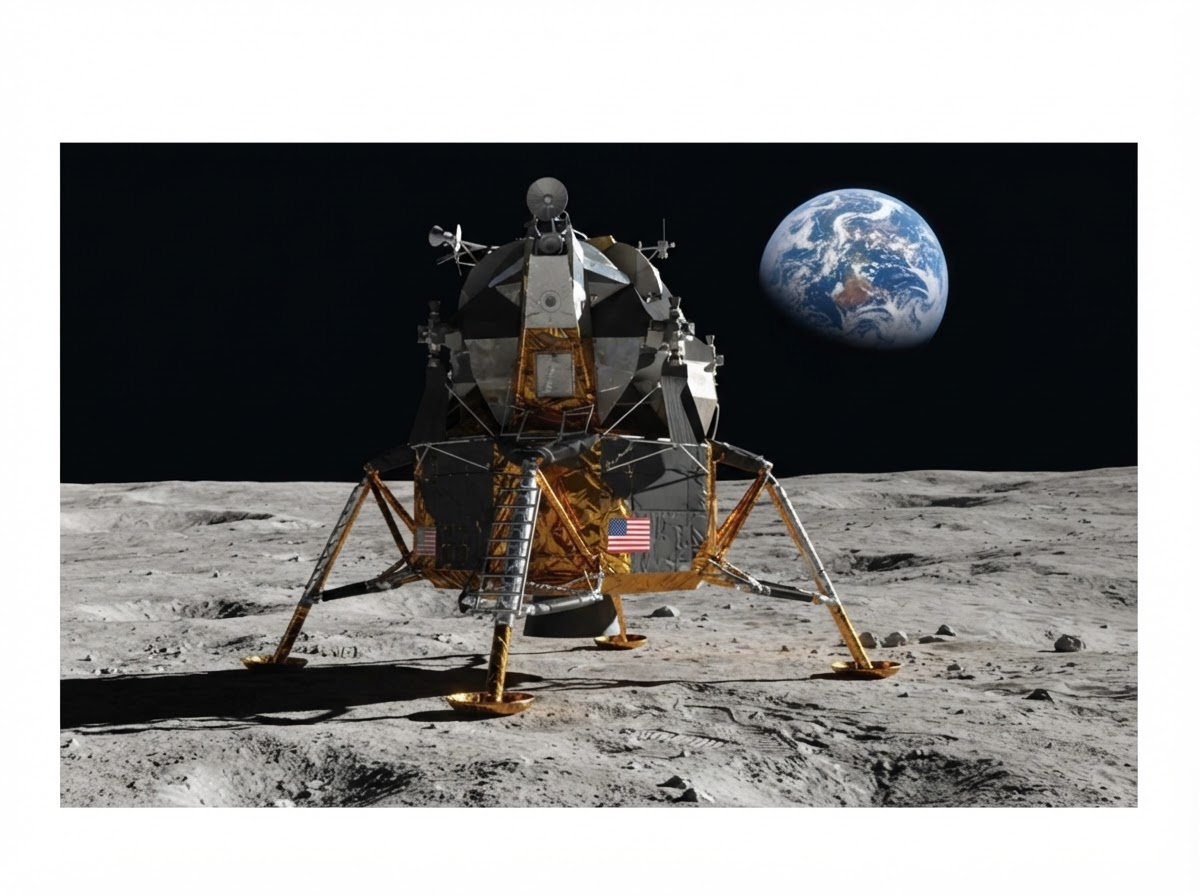
On July 20, 1969, the lunar module, named 'Eagle,' separated from the command module 'Columbia.' Neil Armstrong and Buzz Aldrin were inside the Eagle, preparing for the most challenging part of the mission: landing on the Moon. Michael Collins remained in Columbia, orbiting the Moon, waiting for their return. As the Eagle descended, Armstrong had to take manual control to avoid a rocky area, guiding the lander to a smooth, flat spot. With only seconds of fuel left, he announced, "Houston, Tranquility Base here. The Eagle has landed."
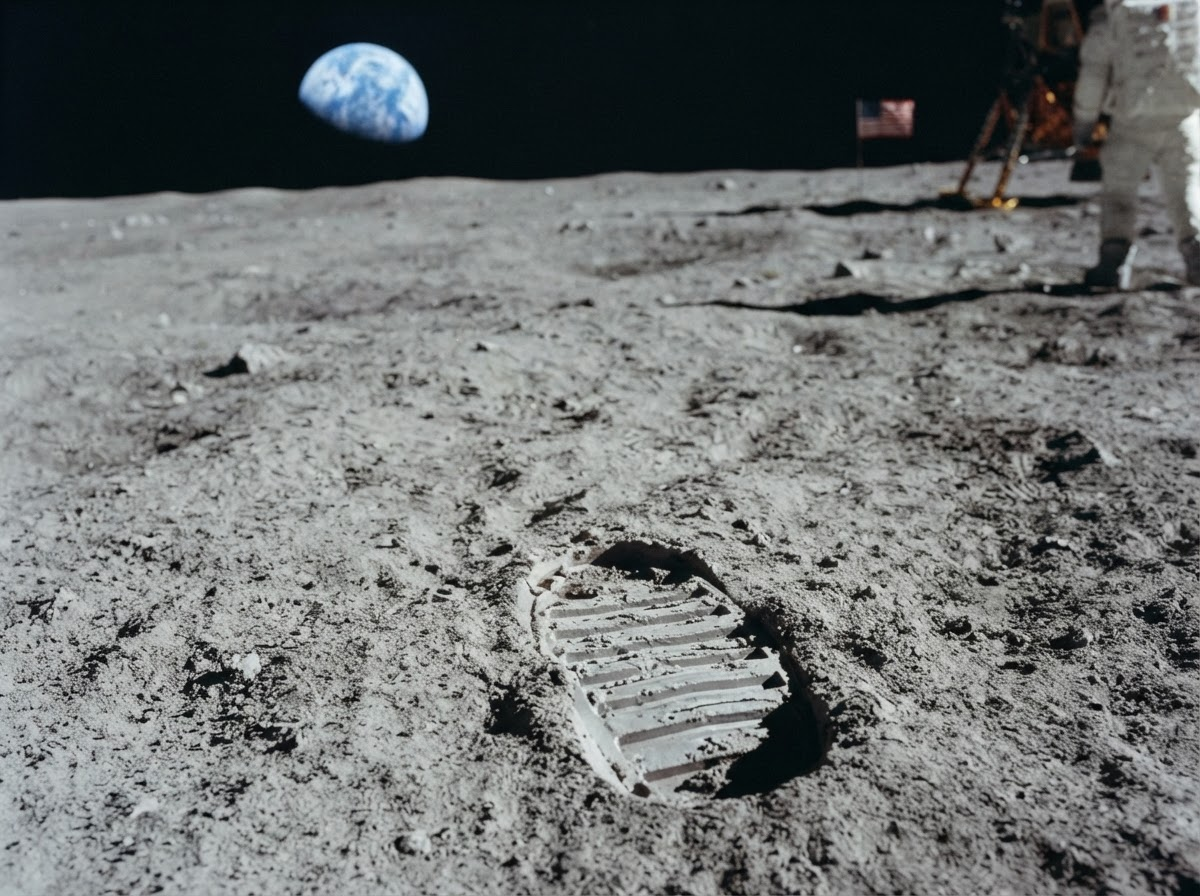
A few hours later, after checking all systems, Neil Armstrong opened the hatch and slowly climbed down the ladder. As his foot touched the lunar surface, he spoke those famous words: "That's one small step for man, one giant leap for mankind." Buzz Aldrin soon joined him, and together they explored the dusty, gray landscape. They collected Moon rocks, set up scientific experiments, and planted an American flag. Their footprints, left in the fine lunar dust, are still there today, untouched by wind or rain, a silent testament to their incredible achievement.
The Return Home and a Lasting Legacy
After spending about 21 hours on the Moon (with about 2.5 hours walking outside), Armstrong and Aldrin blasted off from the Moon's surface in the upper part of the Eagle. They rejoined Michael Collins in the Columbia command module, leaving the lower part of the Eagle behind on the Moon. The three astronauts then began their journey back to Earth. Their re-entry into Earth's atmosphere was fiery and fast, protected by the spacecraft's heat shield. Finally, they splashed down safely in the Pacific Ocean, where they were picked up by a recovery ship.
The first trip to the Moon was more than just a scientific achievement; it was a moment that united people around the world. Billions watched on television, amazed by what humanity could accomplish. It inspired a generation of scientists, engineers, and dreamers. The Moon landing showed us that with courage, teamwork, and brilliant minds, even the most impossible dreams can come true. It taught us about our Moon, our planet, and what we are capable of as humans. You can celebrate this amazing journey by coloring pictures of rockets, astronauts, and the Moon!
Educational Standards & Fact-Checking
Reviewed by KidsColouring Editorial Team
Educational References & Scientific Sources
Our curriculum and factual articles are synthesized from trusted academic encyclopedias, wildlife conservation bodies, and public science institutions:
- •Smithsonian Institution Educational Resources & National Zoo Archives — Smithsonian Institution
- •National Geographic Kids Science & Animal Encyclopedias — National Geographic Society
- •Encyclopaedia Britannica Academic & Elementary Learning Reference — Encyclopaedia Britannica


