
The Mystery of the Vanished Giants: How Did the Dinosaurs Disappear? at a Glance
Topic Focus
The Mystery of the Vanished Giants: How Did the Dinosaurs Disappear?
Learning Level
Ages 4–10 (Preschool to Grade 4)
Subject Area
Dinosaur Facts
Format
Verified Fun Facts & Guided Exploration
The Mystery of the Vanished Giants: How Did the Dinosaurs Disappear?
Imagine a world where giant creatures roamed the Earth, towering over everything, munching on leaves, or hunting other dinosaurs. For over 160 million years, dinosaurs were the kings and queens of our planet! From the mighty Tyrannosaurus Rex to the gentle long-necked Brachiosaurus, they lived in all shapes and sizes, adapting to different environments and ruling the land, sea, and even the skies.
Then, about 66 million years ago, something truly extraordinary happened. These incredible animals, along with many other plants and creatures, disappeared from the Earth forever. It's one of the biggest mysteries in science! How could such powerful and successful animals simply vanish? Scientists have been working like super-sleuths for decades, piecing together clues from rocks, fossils, and even space, to understand what caused this monumental event. Let's embark on an exciting journey to uncover the main theories about how the dinosaurs went extinct!
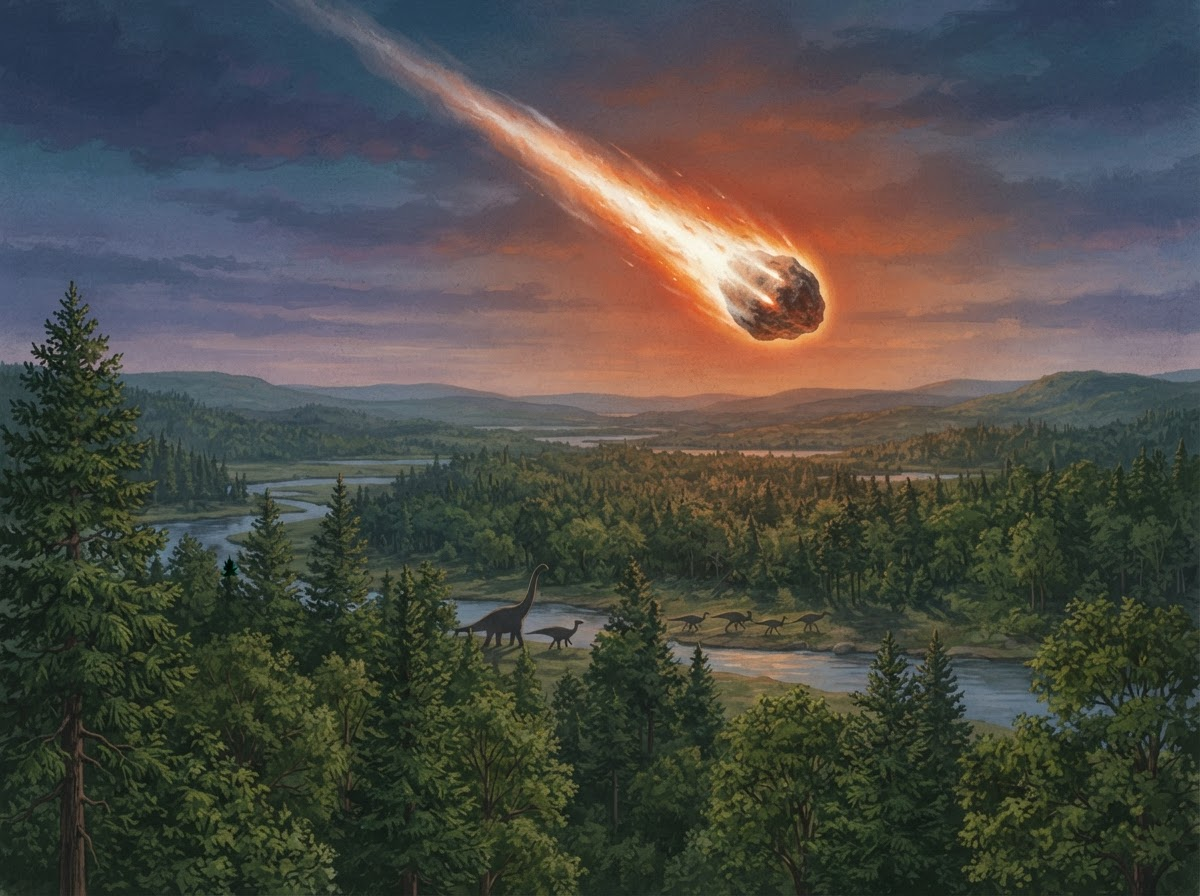
The dinosaurs’ disappearance is Earth's biggest ancient mystery, a puzzle scientists are still solving!
Quick Facts
Dinosaurs lived for over 160 million years.
Their extinction happened about 66 million years ago.
Many other plants and animals also disappeared.
The most accepted theory involves a giant asteroid impact.
Massive volcanic eruptions also played a role.
The extinction event led to a 'nuclear winter' effect.
Mammals, including our distant ancestors, survived.
Modern birds are thought to be descendants of some dinosaurs.
Earth Before the Big Event: The Cretaceous Period
Before we dive into the disappearance, let's set the scene. The time just before the dinosaurs went extinct is called the Cretaceous Period. During this time, Earth looked quite different. The continents were still moving, but they were starting to look more like they do today. The climate was generally warmer than it is now, and lush forests covered much of the land. Dinosaurs were thriving!
There were huge plant-eaters like the Triceratops with its three horns and bony frill, and the fearsome T-Rex, a top predator. Flying reptiles called pterosaurs soared through the air, and giant marine reptiles swam in the oceans. Life was abundant and diverse. But underneath this thriving world, geological forces were at play, and a much bigger threat was hurtling through space, unseen and unknown to the dinosaurs.
The Giant Asteroid Impact: A Catastrophic Collision
The leading scientific theory for dinosaur extinction is that a massive asteroid, about 6 to 9 miles (10 to 15 kilometers) wide, slammed into Earth. Imagine something as big as Mount Everest hitting our planet! Scientists believe this impact happened in what is now the Yucatán Peninsula in Mexico, creating a huge crater called the Chicxulub Crater, which is buried under layers of rock.
What would happen if such a giant rock hit Earth? The impact would have been unbelievably powerful, more energetic than millions of atomic bombs exploding at once. It would have caused:
Massive Earthquakes and Tsunamis: The ground would have shaken violently, and giant waves, called tsunamis, would have crashed onto distant coastlines.
Fiery Blast and Wildfires: The impact would have instantly vaporized rock and water, creating a superheated blast that ignited wildfires across continents. Soot and smoke would have filled the air.
Dust and Debris Cloud: Trillions of tons of dust, ash, and debris would have been blasted high into the atmosphere, circling the globe.
This huge cloud of dust and ash would have blocked out the sun, plunging Earth into a long, dark 'impact winter'. Without sunlight, plants couldn't grow, leading to a collapse of the food chain. Plant-eating dinosaurs would starve, and then the meat-eaters would have nothing to hunt. [inlinePrompt: A dramatic illustration of a massive asteroid streaking across a prehistoric sky towards Earth, with a fiery trail, seen from a distance over ancient forests.]
Volcanic Fury: Another Powerful Force
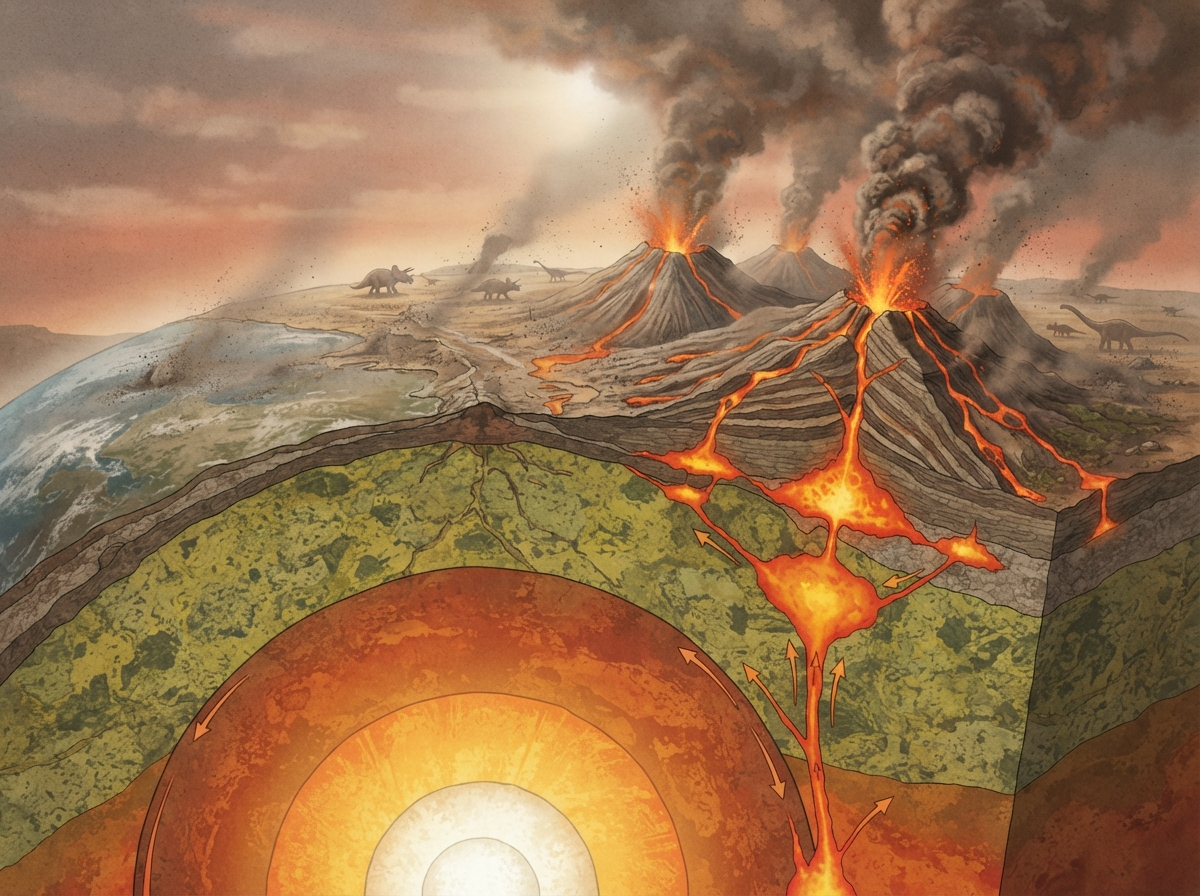
While the asteroid impact is the most accepted theory, some scientists believe that massive volcanic eruptions also played a significant role, or perhaps even started before the asteroid hit, weakening the dinosaurs' world. In an area of India known as the Deccan Traps, there's evidence of colossal volcanic activity that lasted for hundreds of thousands of years around the same time as the extinction event.
These eruptions were not like the volcanoes we see today. They released enormous amounts of lava, covering vast areas, and spewed out huge quantities of gases and dust into the atmosphere. These gases, like sulfur dioxide, could have caused significant climate change, cooling the planet first and then leading to long-term warming. This constant change and stress on the environment could have made it harder for dinosaurs and other life forms to survive, perhaps making them more vulnerable to the asteroid's final blow. [inlinePrompt: A detailed cross-section diagram showing Earth's layers, with magma rising from the mantle to form volcanic eruptions on the surface, depicting the Deccan Traps event.]
The Aftermath: A Changed World
No matter the exact combination of events, the result was a drastically changed world. The Earth's climate swung wildly, food sources vanished, and habitats were destroyed. This period of rapid and extreme environmental change is what ultimately led to the extinction of about 75% of all plant and animal species on Earth, including most dinosaurs.
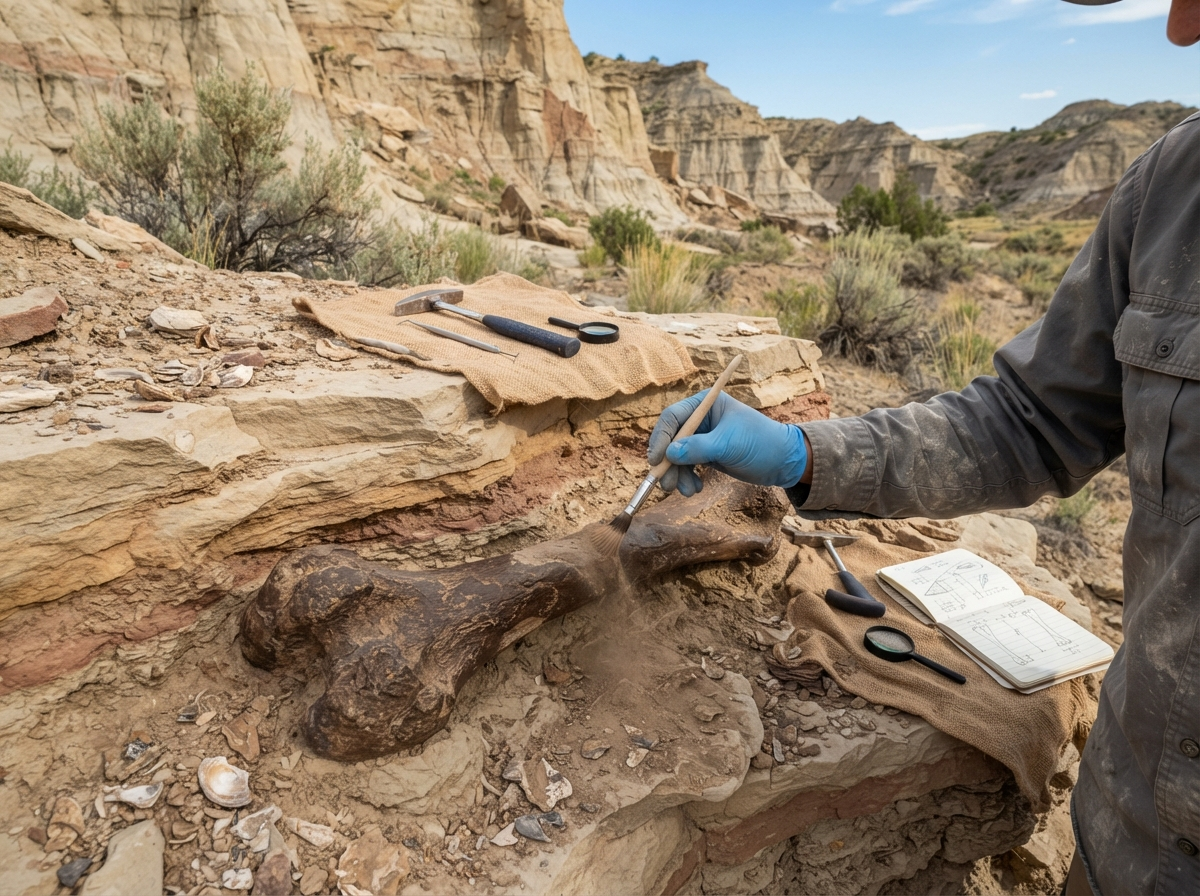
However, not everything died! Some animals and plants were able to survive. Small mammals, birds (which are thought to be direct descendants of some feathered dinosaurs!), crocodiles, turtles, and some fish were among the survivors. These creatures were often smaller, could hide in burrows, or could survive on different food sources, allowing them to weather the storm and eventually thrive in the new world without the giant dinosaurs. [inlinePrompt: A fossilized dinosaur bone partially exposed in sedimentary rock layers, with geological tools nearby, suggesting scientific discovery.]
Unraveling the Clues: How Scientists Know
How do scientists figure all this out? They are like detectives, looking for clues! One of the biggest clues for the asteroid theory is a thin layer of clay found all over the world at the exact geological boundary when the dinosaurs disappeared. This layer contains a rare element called iridium, which is much more common in asteroids than on Earth's surface. This 'iridium layer' points strongly to an extraterrestrial impact.
Scientists also study fossils to see which animals disappeared and which survived. They look at rock layers to understand ancient climates and volcanic activity. By combining all these pieces of evidence, they build a picture of what happened millions of years ago. The story of the dinosaur extinction is a powerful reminder of how interconnected life on Earth is and how even the biggest, most powerful creatures can be affected by catastrophic events.
If you're curious about these incredible creatures, why not explore our free dinosaur coloring pages? You can bring your favorite prehistoric giants to life with your own colors, imagining them in their ancient world before that fateful day!
Educational Standards & Fact-Checking
Reviewed by KidsColouring Editorial Team
Educational References & Scientific Sources
Our curriculum and factual articles are synthesized from trusted academic encyclopedias, wildlife conservation bodies, and public science institutions:
- •Smithsonian Institution Educational Resources & National Zoo Archives — Smithsonian Institution
- •National Geographic Kids Science & Animal Encyclopedias — National Geographic Society
- •Encyclopaedia Britannica Academic & Elementary Learning Reference — Encyclopaedia Britannica


